How much does a smart intercom cost for a building? What drives the price and how it's split
Published 7/28/2026 · Updated 10/22/2026
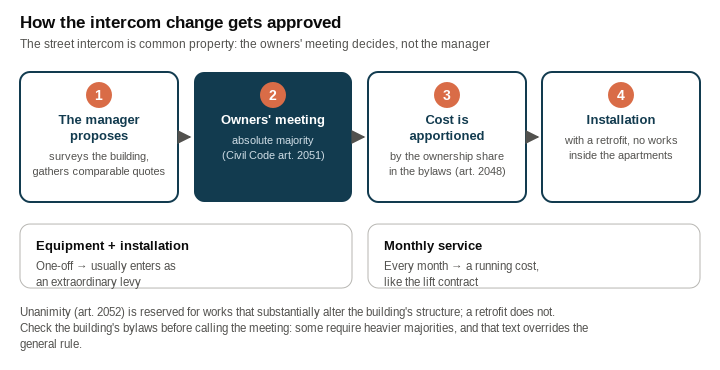
When a building administrator brings a smart-intercom quote to the owners’ assembly, the question that decides the vote is never “how much is the hardware?” but “how much does each apartment pay, and what do we stop paying in exchange?”. Answering it well takes three things: knowing what moves the price from one building to the next, how it fits into the expensas, and what to compare it against.
How is a smart intercom priced?
A retrofit like DoorLink is billed in two parts: a one-time installation for the building, with hardware and labor included, and a monthly service per apartment billed to the building. There’s no list price that works for every building, because two buildings with the same number of units can have very different intercoms, wiring and street panels. That’s why we quote each building after seeing its intercom.
Watch out when comparing against other quotes: many market prices are “hardware only”, without installation. The full market snapshot — QR, retrofit and complete systems, with dated prices — is in smart intercoms in Argentina; here we focus on the building’s own math.
What moves the cost from one building to another?
There are four variables, and it’s worth having them at hand before asking for any quote:
- The number of apartments. It sets the monthly service, which is per unit, and it weighs on the installation. But a big building also divides the one-time cost across more apartments, so each unit’s share doesn’t grow at the same rate.
- The intercom type and wiring. Most Argentine buildings run 4+n or 5+n wire systems — Commax and Fermax among them — and a retrofit works on top of those runs. If the wiring is sound, it doesn’t need redoing, which is precisely a full replacement’s biggest expense. If there are cut sections or old splices, the job grows.
- The state of the street panel. With the original panel working, it stays and visitors keep pressing the same button. If the panel was stolen or destroyed, there’s nothing to retrofit and DoorLink installs the complete system, with its own panel; that’s a different scope of work, and it’s quoted as such.
- Entrances and features. A building with a single door isn’t the same as one with two street panels, a garage or a service entrance. Each extra entrance adds equipment and work, just as it does in a traditional maintenance contract.
With that data — how many units, what intercom brand, what state the panel is in and how many entrances there are — a quote stops being a shot in the dark. A photo of the street panel already settles a good part of it.
How much does each apartment pay?
What the building pays is prorated by the percentage the bylaws assign to each unit, not split evenly (unless the bylaws say otherwise). With that in mind, the important reading is this: the installation — the scary line in the quote — is a one-time payment divided across every unit. The number the assembly should actually debate is the monthly one, because that’s what stays in the expensas forever. Which is why it’s worth comparing it against what the intercom already costs today.
What is the building paying today for the old intercom?
An aging intercom isn’t free: it’s paid for in repairs, and sometimes in a maintenance subscription that’s already in the expensas. Dated references:
- Each technician visit runs around ARS 36,800 to 56,800 in labor alone (Genz Clima 2026 guide); Home Solution’s indicative list, checked July 20, 2026, goes from ARS 38,328 to 165,932 depending on the job, materials not included. Emergency or after-hours calls add a 20% to 50% surcharge.
- A monthly intercom-maintenance subscription is a standard expensas line item: CAEPE (the Argentine chamber of intercom companies) publishes reference values from surveys of professionals, with surcharges of 10% to 25% for each additional street panel or unit. If your building pays one, that number is already on every month’s statement.
- Chronic failures repeat. In old installations, the in-apartment handsets and the degraded apartment wiring are the parts that fail most, producing those intermittent faults that come back every few months. The breakdown by failure type is in my intercom isn’t working.
To compare properly, the administrator has to build the current intercom’s annual number: last year’s repairs + subscription (if any) + emergency surcharges. That’s the new quote’s real rival — not zero.
Does the investment pay itself back? The honest math
It depends on the building, and saying so up front is what makes the rest of the math credible.
If the intercom fails often, the comparison favors the retrofit. The test is simple: divide the one-time installation cost by what a technician visit costs and you’ll see how many visits it equals; a building with chronic failures burns through several a year, with surcharges when it’s urgent. On top of that, the retrofit takes exactly the most failure-prone parts out of the critical path: the call moves to residents’ phones, so a broken in-apartment handset stops being an urgent complaint. Unpredictable repair spending turns into a fixed, budgetable monthly.
If the intercom works fine and barely generates costs, the math is different and it’s worth saying plainly: the monthly fee is a new cost, and what the building buys isn’t savings but a service the old intercom doesn’t provide — answering from your phone wherever you are, opening the door remotely, and no longer depending on being next to the handset. There are buildings where that justifies the spend and buildings where it doesn’t; that’s an assembly decision, not a brochure’s.
Between those two extremes there’s a practical tipping point: if the building already calls the technician several times a year and pays a subscription on top, it’s paying in unpredictable installments for something that never gets better. The full discussion between repairing, retrofitting or replacing the whole system is in replace or modernize the intercom.
Installation as a special assessment, service as a running cost?
That’s the natural way to frame it. The installation is an improvement to common property decided by the assembly — the textbook case of an expensa extraordinaria (special assessment); the monthly service, on the other hand, is just another running cost on the statement, like the elevator contract. Argentina’s Civil and Commercial Code obliges every owner to pay both the ordinary expensas for administration and repair of common property and the extraordinary ones passed by assembly resolution (art. 2048), and both are prorated by the percentage the bylaws assign to each unit — not split evenly, unless the bylaws say otherwise.
The context doesn’t help anyone hide numbers: expensas in Buenos Aires City rose 75% during 2025 against 31.5% inflation (Octavo Piso’s survey of consorcios, January 2026), driven precisely by contracted maintenance services. In that climate, an assembly warms much more to a fixed, transparent monthly than to a story of unpredictable repairs. What majority you need to approve it and how to bring the proposal to the assembly has its own guide: a smart intercom for the building.
How do you compare it against a repair or replacement quote?
By putting everything in the same unit of measure. Three rules that dismantle most misleading comparisons:
- Total against total. A “hardware only” price can’t be compared with one that includes hardware and installation. Equipment needs labor added on top, and a full replacement needs the rewiring, which in buildings of ten units or more usually costs more than the equipment itself.
- The monthly counts too. Cheap hardware with an expensive subscription can end up above pricier hardware with none, and vice versa. The five-year total-cost-per-apartment formula is in how to choose a smart intercom.
- Against what you already spend, not against zero. A one-off repair always looks cheapest because you look at it one at a time. Add up last year’s and only then compare.
What should you do with this math?
Bring it to the assembly complete. On one sheet: (1) the one-time installation cost and what it comes to per apartment by percentage; (2) the monthly per unit; (3) what the building spent on the intercom over the last twelve months, with the repair invoices and the subscription if there is one. With those three numbers on the table, the vote becomes a concrete comparison instead of a debate of impressions.
The honest fit, once more: the retrofit’s math works better the more the building spends today keeping a failing intercom alive, and worse if the current system runs perfectly and nobody misses answering from their phone. Work out your building’s real annual number before the assembly, and for the first two lines of the sheet, send us a photo of your intercom on WhatsApp and we’ll tell you what it costs for your building. If you’d rather, write to us through the contact form.