Smart intercoms in Argentina (2026): options and prices
Published 7/20/2026
If you’re thinking about modernizing a building’s intercom, Argentina today offers three families of solutions with very different logic and prices. This guide sorts them out and puts dated numbers on them, because with inflation a price without a date says nothing.
What options are there today?
Three paths: replace the whole system, install a wireless QR/virtual intercom, or retrofit the panel that’s already there. They solve different problems.
Full replacement is the classic path: pull the old panel, install a new video or IP system, and often redo the wiring. This is where the traditional brands of Argentine buildings play (TEGUI, FERMAX, GOLMAR), along with newer hardware systems with facial recognition and access control like Hipcam’s. It’s the most complete option, the most expensive, and the one demanding the most construction work.
QR or virtual intercoms are the newcomers: instead of indoor handsets, the visitor scans a code at the door, picks the apartment, and the call reaches the neighbor’s phone. Tappbell (with three street formats — a touch panel, a vandal-proof wireless cabinet and a virtual QR — plus geolocation validation so only someone near the door can ring) and Bellify are two established names. There’s also Portero Virtual, from Salta, which now quotes each case individually, so any old price list you see floating around no longer applies.
The retrofit, DoorLink’s family, is the middle path: it keeps the street panel and the wiring, and only adds the electronics that route the call to the phone. The visitor keeps pressing the same physical button as always; the building doesn’t change its appearance. The mechanics are explained in how a smart intercom works.
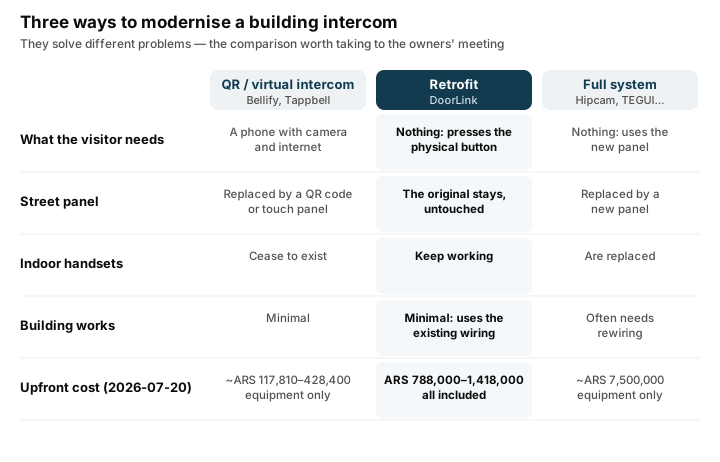
The three families, side by side:
| QR intercom (Bellify, Tappbell) | Retrofit (DoorLink) | Full system (Hipcam, TEGUI…) | |
|---|---|---|---|
| What the visitor needs | Phone with camera and internet | Nothing: presses the physical button | Nothing: uses the new panel |
| Street front | Replaced by a QR code or touch panel | Original, untouched | Replaced by a new panel |
| Construction work | Minimal | Minimal: reuses existing wiring | Rewiring is common |
| Indoor handsets | Cease to exist | Keep working | Replaced |
| Upfront cost (Jul 20, 2026) | ~ARS 117,810–428,400, equipment only | ARS 788,000–1,418,000, all included | ~ARS 7,500,000, equipment only |
| Monthly fee | Vendor-dependent | USD 8 per apartment (USD 3 floor) | Vendor-dependent |
What does each option cost?
The three families play in different leagues. These are the numbers we could verify on live pages as of July 20, 2026.
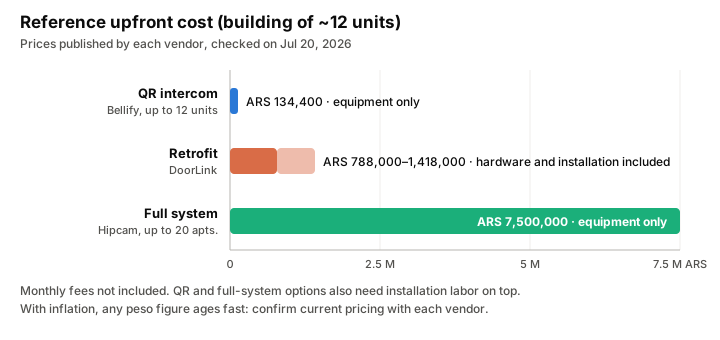
QR intercoms are the cheapest entry point. Bellify’s store (tienda.bellify.io, checked July 20, 2026) lists equipment by unit count: around ARS 117,810 for up to 6 units, ARS 134,400 for up to 12 and ARS 428,400 for up to 24, plus a one-time charge of ARS 10,000 + VAT per extra unit. In mid-2024 they ran about ARS 28,750 for a house and ARS 156,500 for 24 units: inflation shows, which is why you should confirm the price at the store before deciding.
Full hardware plays in another league. Hipcam’s smart-doorman system for buildings (video intercom, door controller and licenses for up to 20 apartments) listed at around ARS 7,500,000 in its official store (shop.hipcam.com, checked July 20, 2026), far above the ARS 3,950,000 it cost in mid-2024. A typical companion in this world, the Nexxt NHS-D100 smart lock, ran about ARS 125,000 in mid-2024; today it shows as out of stock in the stores we checked, so treat that as an old reference only.
On top of any of this equipment comes labor. For 2026, intercom installation runs around ARS 36,800 to 56,800 (labor only, indicative; Genz Clima 2026 guide). The most solid sector reference is CAEPE (the Argentine chamber of intercom companies), which publishes suggested installation prices at caepe.org.ar, including a list for IP intercoms; at the time of writing the page points to the list without showing the values, so ask your installer for the current table.
How does DoorLink compare?
DoorLink is the retrofit option and its price is designed to be predictable: installation costs about ARS 788,000–1,418,000 depending on the building (USD 500–900 with hardware and installation included, at the official exchange rate of July 20, 2026), and the service runs about ARS 13,000 per apartment per month (USD 8; floor of ARS 5,000 / USD 3 in lower-income areas), billed to the building. On the site you can estimate the cost for your building in a minute, with the day’s peso conversion, precisely so inflation doesn’t fossilize a number.
The deeper difference isn’t the price but what you avoid. By keeping the panel and the wiring, the retrofit skips a replacement’s biggest cost (redoing the cable runs) and its most failure-prone parts (the indoor handsets). And there’s a difference no quote shows: the person standing at the door changes nothing about what they do. They press the same button they pressed thirty years ago, with no phone, no data, no instructions. That comparison has its own article: physical button or QR code.
The honest fit: DoorLink is at its best when the building wants to keep the physical panel and avoid construction. If the panel is already destroyed or stolen and has to go anyway, a QR intercom like Bellify or Tappbell makes more sense, because it doesn’t depend on preserving anything. And if the goal is video with new hardware in every unit, that pushes toward a full system. Choose the family by what you want to keep, not by the prettiest brochure.
What to check before deciding?
Four questions that separate a good decision from a headache:
- The wiring. Does the solution reuse the current runs and panel, or does it demand redoing them? That single question separates a retrofit from a major job, and it’s the one that moves cost most.
- The owners’ association’s approval. The intercom is a common element: any significant change usually needs the assembly’s sign-off. Check the co-ownership rules before moving. A practical note: a retrofit that doesn’t touch the façade tends to be a much shorter vote than a new front.
- The monthly total per apartment. Don’t look only at the equipment: add per-unit charges, licenses and fees. Cheap equipment with an expensive fee can end up costing more than the reverse.
- Who provides support. When something fails, who do you call? Confirm whether the vendor offers local service, how fast they respond, and what’s covered. An intercom is building infrastructure: support matters as much as price.