Replace the intercom or modernize it? Retrofit vs. new installation
Published 7/20/2026
When a building’s intercom reaches the end of its useful life, the owners’ association has two paths: replace the whole system with a new one, or modernize (retrofit) on top of what’s already installed. They differ in construction work, in cost, and in what the building has to vote on. This comparison exists so the decision doesn’t rest on whichever quote arrives first.
What does replacing the whole system involve?
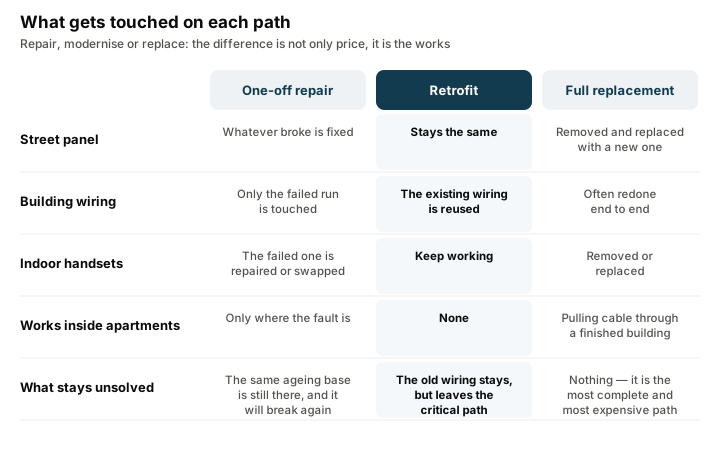
Replacing the entire intercom means pulling the street panel, pulling the indoor handsets and, very often, redoing the wiring that ties it all together. That last point defines the bill: in buildings of ten units or more, according to installers, the cabling and its labor usually cost more than the equipment itself.
That’s why a full replacement gets expensive fast. You’re not just paying for devices: you’re paying for the job of running cables through an already-built building, with its ceilings, its walls and its surprises. And there’s a prior step you shouldn’t skip in Argentina: the intercom is a common element, so a significant change generally needs the assembly’s approval. Check the co-ownership rules and bring it to the assembly before moving, so both the decision and the expense are backed.
What is modernizing (a retrofit)?
Modernizing means using what already works (the street panel and the existing wiring) and adding the electronics that route the call to the phone. Only the part that needs changing gets changed.
The logic rests on where failures are born. Most intercom problems live in the indoor handsets and the apartments’ old wiring; the street panel is usually the sturdiest part. A retrofit keeps the panel and moves answering to the phone, removing from the installation exactly the parts that break most, with no construction work.
There’s a side effect many associations end up valuing more than the savings: the building doesn’t change its face. The front keeps its usual panel, the visitor presses the same button, and no neighbor has to approve how the façade will look with a new device on it. In buildings with decades-old fronts that are part of the place’s identity, that’s often the argument that closes the vote. The full mechanics are in how a smart intercom works.
What does each path cost?
Cost depends on the building’s size and how much wiring needs touching, so ranges are what’s useful, not a single number. As an international reference (not an Argentine price): in Spain a partial upgrade runs about €600 to 1,200, a full replacement in a small or mid-size building goes from €1,200 to 3,000, and complex jobs exceed €3,000. They show the shape of the expense, not the local value.
In Argentina, the labor anchors are the same as for a repair, and since inflation ages any peso figure within months, it’s more useful to think of it in units of technician time: based on the Genz Clima and Home Solution surveys of intercom labor, a modernization’s labor runs roughly one to several days depending on how much of the interior wiring needs touching, materials not included. Always get a current quote.
A retrofit like DoorLink is quoted differently: it’s a one-time cost with hardware and installation included, plus a monthly per-apartment service, billed to the building. You can estimate the cost for your building in a minute; the underlying difference is that the retrofit avoids a full replacement’s biggest cost, which is redoing the wiring.
How to decide?
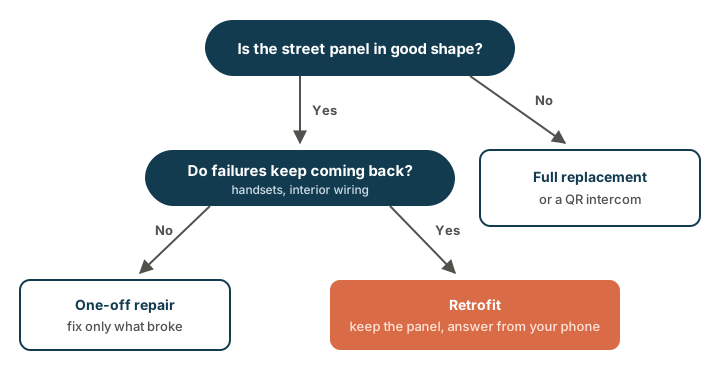
The question that organizes everything is the state of the street panel, because that’s the part a retrofit sets out to preserve.
When does a retrofit NOT make sense?
A retrofit isn’t for every building. If the association already decided to redo the wiring for another reason (a general renovation, cables at the end of their life), much of the savings disappears, because the advantage was precisely not touching the runs.
It also doesn’t fit if the building wants video in every apartment with a new installation: that goal calls for a complete system designed from scratch. And if the street panel is destroyed or stolen, the part the retrofit came to preserve is gone; in that case, replacing everything (or moving to a QR intercom, if the building accepts what that means for visitors) is the reasonable call.
A retrofit shines when the panel is healthy and the problem is the handsets and interior wiring. That also happens to be the most common case in Argentine buildings: the front lasts decades, the insides don’t.