Intercom not working: the 5 faults and what a repair costs
Published 7/20/2026
When a building’s intercom stops working, the first step is understanding which part failed. Only then does it make sense to call a technician or debate replacing everything at the assembly. The good news: failures repeat. Nearly all of them fall into a handful of known categories, and knowing which one you’re in saves you money.
Why did the intercom stop working?
Almost every electric intercom failure is one of five kinds: no communication between the street and the apartment, no power, a door-release that won’t actuate, bad or missing audio, or a failing image (on video intercoms). Each points to a different part of the installation.
Behind them are predictable causes: humidity, dust, vandalism, and the normal wear of equipment that has worked every day for years. In old installations, wiring with degraded insulation introduces noise or static, and loose contacts produce those intermittent failures that come and go with no pattern. Identifying the failure type is step one: it tells you whether the problem is in the street panel, the power supply, or inside one apartment.
It rings but the door won’t open?
If the intercom rings and you can talk but the door won’t open, the problem is in the door-release circuit, not in communication. The usual suspects: the electric strike, the release button, that circuit’s wiring, or the supply feeding it.
The order any technician checks: first that the button actuates, then the strike (it’s a mechanical part, it wears out), and finally the wiring’s continuity and its power. Since it’s a fairly isolated circuit, it’s often fixed without touching the communication system, which keeps the repair cheap.
No call rings at all?
If you press the doorbell and nothing happens, the problem usually sits in the call’s path: the street-panel button, the terminal connections, or the power supply.
The street button is the part that suffers most. It lives outdoors, gets pressed hundreds of times a week, wears out or jams. Then come loose terminals — connections that lose contact over the years — and finally a supply that no longer delivers voltage. A technician rules out those three points before suspecting the indoor equipment.
Failing building-wide, or just in your apartment?
Check this before calling anyone, because it splits the diagnosis into two worlds. If no apartment receives calls, the problem is in the shared parts: the power supply, the breakers, or the street panel’s board. If only your unit fails, the problem is local: your handset or your apartment’s wiring.
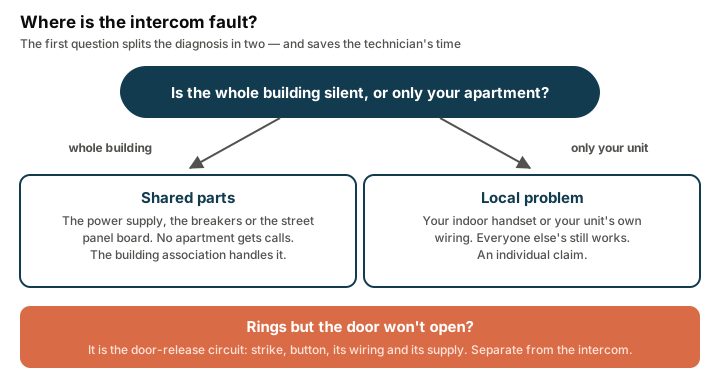
Showing up with that answer saves the technician time, and the technician’s time is exactly what you’re paying for.
What does a repair cost in Argentina?
Repairs are almost always quoted as labor, with materials billed separately. A peso figure from this year is stale within months, so it’s more useful to think of it in units of technician time: based on the Genz Clima and Home Solution surveys of intercom labor, a typical repair runs roughly half a day to a full day of technician labor, depending on the complexity of the fault and whether a part needs replacing.
Two warnings. Emergency or after-hours service usually adds a 20% to 50% surcharge. And for a firmer reference than a lone installer’s number, look at the sector chambers’ tables: CAEPE (the Argentine chamber of intercom companies) and AAIERIC’s suggested labor costs, which publish dated values — always ask for the current one, since this is exactly the kind of figure inflation ages fast.
Repair or modernize?
Repair when the failure is isolated and the rest of the system is reliable. Modernize when failures keep coming back. If you’re calling the technician every two months for something different, you’re paying for repairs on a base that will keep breaking.
Between repairing and replacing everything there’s a third option: a retrofit. Most intercom failures live in the indoor handsets and the apartments’ old wiring; the street panel is usually the most robust part. A retrofit keeps that panel (the visitor keeps pressing the same button — no construction work, no change to the façade) and moves call answering to the phone, removing from the installation exactly the parts that break most. That’s how DoorLink works: installation is a one-time cost with hardware included, and the monthly per-apartment service is billed to the building.
It isn’t always the answer: sometimes a one-off repair is plenty. But when failures turn chronic, modernizing usually costs less than fixing the same thing three times a year, and you can estimate the cost for your building in a minute before deciding. The full comparison is in replace or modernize the intercom, and smart intercoms in Argentina lays out the options available today for an apartment, with prices.