Universal intercom handset: what it actually fixes (and what it doesn't)
Published 8/24/2026
When your apartment’s handset stops working, the search almost always ends up in the same place: a “universal electric intercom handset” at a hardware store or on MercadoLibre. They exist, they’re easy to find, and in the right case they’re the fastest and cheapest fix there is. The problem is the word “universal”: it doesn’t mean what it promises, and buying one without understanding that is the most common way to spend money and still have the same problem.
If you don’t yet know which part of your intercom failed, start with my building intercom isn’t working, which covers the five typical faults. This article is about one specific decision: when buying a universal handset actually fixes something, and when it’s money wasted.
What universal handsets are sold in Argentina?
It’s a real product category, sold by electrical and security retailers, not just informal importers. The two best-documented models are the Commax DP-SS, which as of August 2026 ran ARS 41,500–55,000 depending on the retailer and payment method, and the Netyer T4, with prices spread noticeably wider across retailers — roughly ARS 81,000–180,000 depending on where you buy and whether it’s the list or cash price. Neither is sold through a single official distributor; they show up at several electrical retailers at once, at prices that don’t match each other.
That price spread is itself a clue: this isn’t a market with one clean reference price, so it’s worth getting more than one quote before buying.
Does “universal” mean it works with any intercom?
No, and this is what causes most returns. A “universal” handset works through brand-and-model equivalence tables, not because it’s compatible with any installation. The clearest case is Fermax’s own VEO 4+N Universal handset, which ships with an official table mapping it against more than 50 brands and 100 specific models, terminal by terminal — meaning compatibility is defined model by model, not declared in the abstract.
There’s an even more direct, slightly ironic example: the Commax DP-SS mentioned above is sold by one retailer under the name “universal handset,” but it only works with Commax’s own panel families (DR, KM, AM, UM). The manufacturer confirms this itself, and so — unintentionally, while competing for the same sale — does a MercadoLibre seller offering the same handset titled “Commax Only, Not Universal.” When even the competition has to point out that “universal” isn’t true for that product, that says something about how much to trust the label.
What should you check before buying one?
First, count the wires. Traditional systems use 4 or 5 conductors split by function: power, audio, and door release. Newer digital systems consolidate audio, data, and door release onto just 2 wires. These are mutually incompatible topologies — there’s no adapter that converts one into the other — and some universal handsets, like the Netyer T4, specifically require a 5- or 6-wire system and won’t work with anything else. If your building has a 2-wire digital system, don’t bother with a generic “universal” handset: those systems are too manufacturer-proprietary for generic repair, and you need to go straight to that specific brand, not a universal fix.
Then, the street panel’s brand. As with the Commax DP-SS, “universal” in the product name guarantees nothing: you need to confirm against the actual brand and model of your panel, not the handset’s marketing.
What does a new handset fix, and what doesn’t it fix?
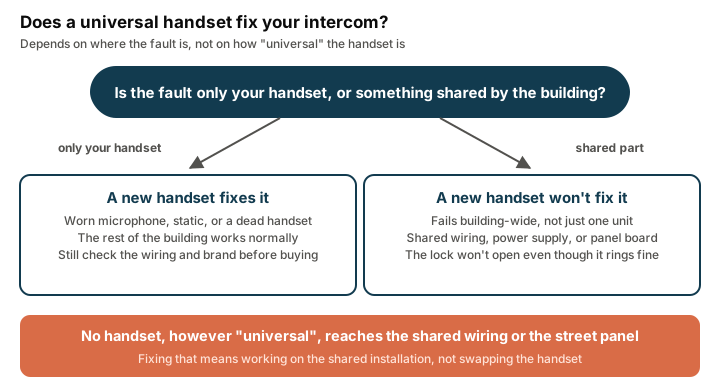
This is the central question, and the answer has more technical backing than it might seem. A new handset — universal or original-brand, it doesn’t matter — fixes anything isolated to the interior unit: the classic crackling noise from a worn carbon microphone, static, or a handset that’s simply dead and won’t ring or transmit at all. In those cases the rest of the building keeps working normally, and swapping the handset fully resolves it.
What a new handset does not fix is any fault on the shared side: deteriorated common wiring or corroded splices, the power supply, the street panel’s electronic board, or an electric door lock that doesn’t respond. That same crackling noise can have two completely different causes — a worn microphone in the handset, or humidity in a shared-wiring splice — and only the first one is fixed by buying a handset. This isn’t our opinion: it’s spelled out explicitly in the technical repair manual published by CAEPE (Argentina’s intercom trade chamber), which walks through, step by step, how to separate faults that originate in the interior handset from faults that originate in the building’s shared parts.
How do I know if it’s the handset or the building?
The question that splits the two worlds is simple: does the same thing happen to your neighbors, or just to you? If the whole building has the same problem, it’s the shared side — power supply, breakers, or the panel board — and no new handset, universal or not, will fix it. If it only happens to you and everyone else is fine, then it’s a genuine candidate for a handset fix. The full diagnostic, including what to do when it rings but the door won’t open, is in my building intercom isn’t working; and if your building specifically runs Commax, the exact topology — what’s shared and what’s per-apartment — is covered in Commax intercom: how to modernize it.
When is a universal handset the right answer?
When the diagnosis shows the fault is yours alone and the interior unit is worn out or dead, buying a handset — after checking the wiring and brand first — is honestly the simplest, cheapest fix there is. Nothing needs modernizing for that, and proposing a full retrofit to replace a worn microphone would be a waste of money.
The problem shows up when a universal handset gets used as a patch for a fault that’s actually in the wiring or the panel: the complaint comes back, because whatever was actually broken never got touched. It’s a known pattern — fixing the same one-off symptom over and over on a base that stays the same — and it’s covered in more detail in replace or modernize the intercom.
What if it’s the shared wiring or the street panel?
That’s where no handset, however universal, can reach. But there’s an alternative that also isn’t replacing the whole system: a retrofit like DoorLink connects directly at the street panel’s terminal block, the point where both the common wiring and every apartment’s individual conductor terminate. From there, the call goes out over the internet to the resident’s phone instead of depending on the interior wiring being intact.
That has a concrete payoff for exactly the case a handset can’t fix: if one apartment’s individual conductor is broken inside the wall, that run simply stops being used — nothing needs to be opened up to fix it. And if the street panel itself is damaged or beyond repair, it can be replaced without touching the rest of the building’s wiring, which keeps working.
DoorLink installation is a one-time cost with hardware included, and the monthly per-apartment service is billed to the building’s HOA — the exact number for your building, without relying on a conversion inflation will make stale, takes a minute in the calculator. It’s the right call when the fault is the building’s, not the handset’s; for the one-off worn microphone, keep buying the handset. It works with the 4+n and 5+n wire systems most Argentine buildings use, Commax and Fermax among them — and on a retrofit, the original handset keeps working alongside it, so anyone who’d rather keep answering from the kitchen loses nothing.
The short version
A universal handset is the right tool for exactly one problem: a worn-out or dead interior unit, with everything else in the building working fine. For that, “universal” on the box isn’t enough — check the wiring and brand before paying. For any fault that belongs to the building and not the handset, no handset, however universal, will fix it; the conversation there is about wiring, power supply, or the panel, not which handset to buy. Not sure which case you’re in? Get in touch and we’ll take a look before you spend on something that won’t fix it.