Is a smart intercom easy for older adults to use?
Published 8/2/2026 · Updated 9/24/2026
Whenever a building debates modernizing its intercom, sooner or later someone asks: “what about the older residents?”. It’s a fair question, and it deserves better than a brochure’s “it’s super easy”. Here’s the answer in two parts: what technology older adults in Argentina actually use — with INDEC data, not impressions — and what happens with the neighbor who still wants nothing to do with an app. Spoiler on the second part: they don’t have to change a thing — their classic handset keeps working.
Can older adults use a smart intercom?
Yes — and the data surprises more than one assembly: the cellphone is precisely the technology older Argentines already master. According to INDEC’s ICT-use module of the EPH household survey (Q4 2024, urban agglomerations), 85.1% of people aged 65 and over use a cellphone and 74.2% use the internet, versus barely 17.8% who use a computer. The trend is just as clear: at the end of 2020, cellphone use in that group stood at 71% — fourteen points lower than today.
The image of the disconnected grandparent has less and less to do with reality. The average 65+ resident of an Argentine city owns a cellphone, uses it daily, and gets online through it: among 65+ internet users, 81.1% access it from their phone (National Survey of Cultural Consumption 2022, published in INDEC’s 2025 older-adults dossier). An intercom that routes the doorbell to the cellphone isn’t asking that person to adopt a new device — it adds one function to the device already in their pocket.
Why is answering just like a WhatsApp video call?
Because it’s deliberately designed around a gesture older adults already perform every week. Again, the data: among 65+ social-network users, WhatsApp is by far the most used — 71%, versus 43.8% for Facebook and 16.3% for Instagram (ENCC 2022) — and Argentine academic research documents that this use includes texts, voice notes, and video calls with family and friends. Video calling is not new technology for this group: it’s how they talk to their grandchildren.
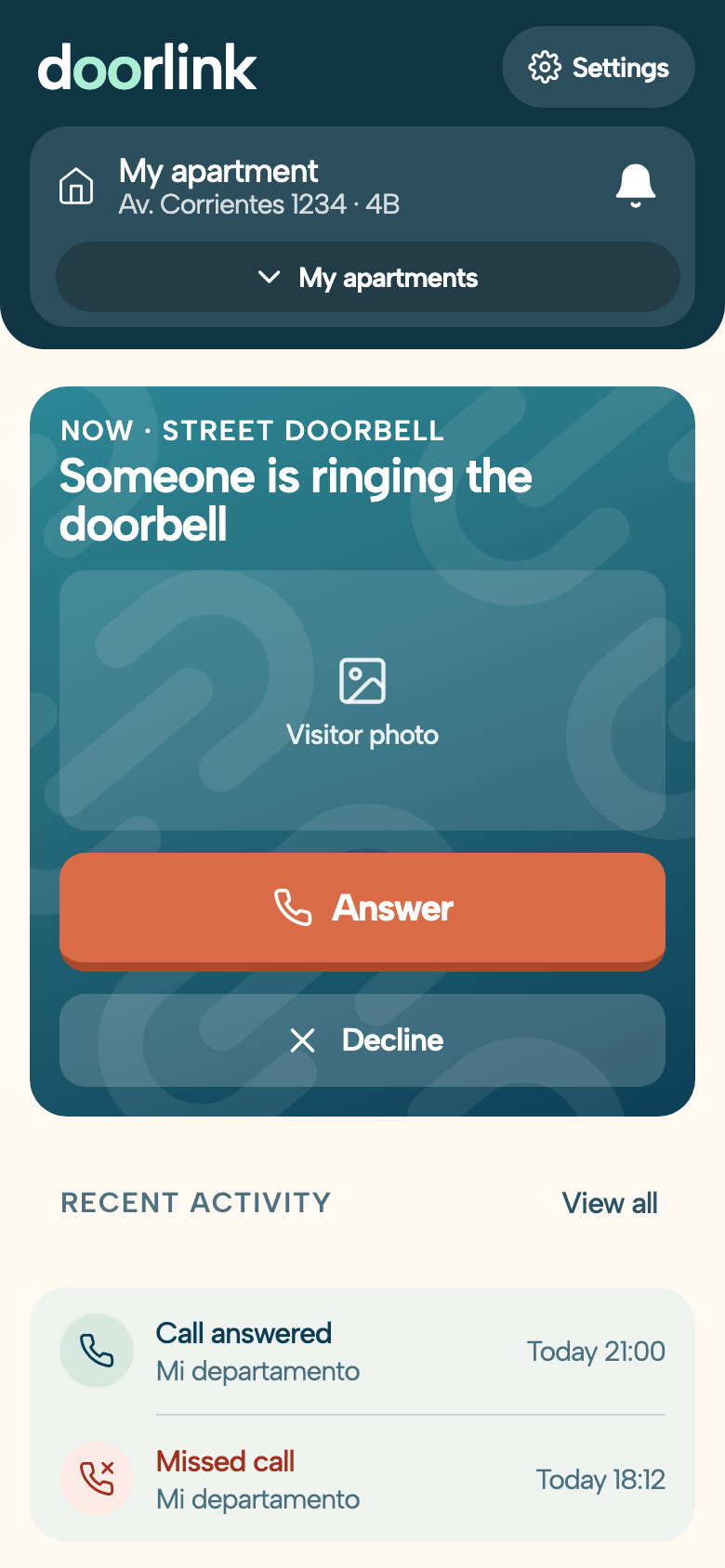
DoorLink uses exactly that pattern. When someone rings the doorbell, the phone rings the way a video call rings: you answer, you see the person at the door, you talk, and if you want to let them in you slide one large control that says “Slide to open.” No menus, no username-and-password every time, no jargon. As we explain in how a smart intercom works, we tested the call screen with older users who had never used an app like this, under one simple rule: if it needs explaining, it’s badly designed.
What makes an app easy to use at 75?
It isn’t magic or condescension — it’s design, and it’s been studied. A 2023 systematic review (JMIR mHealth, covering 40 usability studies with people over 60) distilled the golden rules: simplify the interface and enlarge the controls — big, well-spaced buttons — plus lean on concrete, familiar icons instead of app conventions nobody ever explained. In plain terms: few options, large text, and every screen resembling something the person already knows.
The cost of ignoring those rules has also been measured. A study published in the journal Comunicar (2015) tested a social app designed for older adults with 65 users aged 60 to 98 in Mexico: only 15% managed to exit the app and just 35% could assign a contact. “I can’t read the text, the buttons are too small,” summed up an 81-year-old participant. Slapping “for seniors” on the marketing doesn’t make an app usable; big buttons and familiar gestures do.
One INDEC figure closes this point: among people 65+ who don’t use the internet, the most cited reason is not lacking a device (11.9%) or the cost (6.8%) but “doesn’t know how to use it” (38.6%, ENCC 2022). The real barrier is the interface, not the hardware. So the right question about a smart intercom isn’t “do the older residents own a cellphone?” — the vast majority do — but “does answering resemble something they already know how to do?”. If the answer is a video call, they already know how to answer it.
What about the neighbor who doesn’t use a smartphone or doesn’t want the app?
They keep answering on the same handset as always — and this is no small print: it’s the difference between a retrofit and the systems that force everyone to switch. DoorLink doesn’t remove the indoor handsets or replace the street panel; it adds a new path — the cellphone — without erasing the old one. The 90-year-old neighbor who wants nothing to do with any of it doesn’t have to download, configure, or learn a single thing: for them, the intercom stays the same intercom.
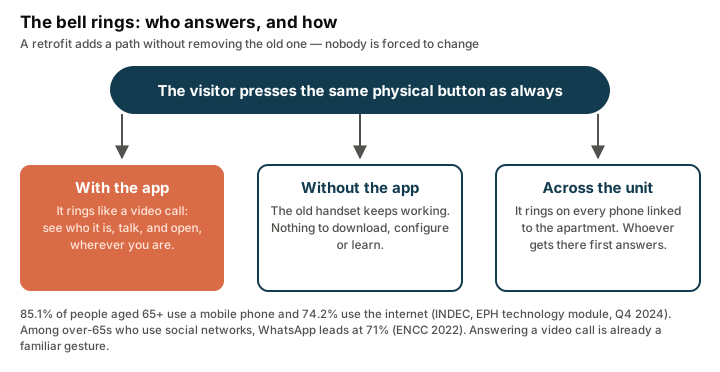
On top of that, every resident of a unit can link their phone, and the call rings on all of them at once. In practice, that means if an older woman lives with her daughter, either of them can answer the door call — whoever gets there first. And for the visitor nothing changes: they press the same physical button as always, no QR codes and no instructions — the comparison with systems that do put demands on the visitor is in physical button or QR code.
Why does this matter more and more in Argentine buildings?
Because buildings age along with their residents. The City of Buenos Aires is the most aged jurisdiction in the country: 17% of the people living in private dwellings are 65 or older (Annual Household Survey 2024), and Argentina ranks among the three most aged countries in South America. The figure that matters most for an intercom: nearly 4 in 10 porteños aged 65+ live alone — 38.2%, and among older women, 45.9% (EAH 2024).
Living alone changes what the doorbell means. There’s no second pair of eyes to peek out, no one else to go downstairs and check. Being able to see and hear whoever is at the door before deciding to open — from the couch, without rushing up, or from a relative’s home when you’re out — is exactly the kind of peace of mind that matters most to an older person living alone, and to the family that calls every day to check on them. The handset only carries a voice; the video call shows who it is.
How do you bring this answer to the assembly?
The “older residents won’t adapt” objection is answered in two moves. First, with the data: 85% of Argentines 65+ already use a cellphone, and answering DoorLink is a video call — the gesture that group already masters through WhatsApp. Second, with the guarantee: nobody is forced, because the handset keeps working exactly as before for anyone who prefers not to change. A retrofit asks nothing of anyone — not the 90-year-old neighbor, not the visitor ringing the bell. It adds without taking away.
That “adds without taking away” is what usually unblocks the vote, because it turns a “we force everyone” debate into a “we give an option to whoever wants it” one. How the approval formally works — what majority the Civil and Commercial Code requires and how the cost is split — is covered in a smart intercom for your building’s HOA, and the per-apartment math in how much a smart intercom costs for an HOA. If you want the exact number for your building, you can get it in a minute with the calculator.