Why Do Break-Ins Happen When Nobody Answers the Intercom?
Published 9/16/2026
Someone rings a random ground-floor buzzer in an apartment building. If nobody answers, they don’t leave — they try the next one. The goal isn’t to break into that specific unit; it’s to confirm that, on that floor, right now, nobody’s home. That confirmation — not the intercom brand, not whether it has a camera — is what decides whether the break-in attempt goes ahead.
Why do break-ins happen when nobody answers the intercom?
Because an unanswered buzzer is the cheapest test an intruder has for confirming an apartment is empty before forcing entry. Several cases documented in Argentine crime reporting describe exactly this pattern: someone rings buzzers, knocks on doors, or calls by phone, and reads no response as the signal to act (Crónica, quoting security specialist Héctor Muzzio). It’s reconnaissance before the act, not a random break-in.
A documented case in La Plata shows the mechanic with names attached: a woman would work through a building’s buzzers, and once she confirmed a given apartment wasn’t answering, she’d signal her accomplice to force entry (0221). The buzzer wasn’t identifying a unit with valuables — it was identifying a unit with nobody on the other end.
One important distinction, because it separates what’s documented from what’s reasoned: no study measures whether having a camera on the intercom changes this outcome. What’s proven is the point above — that the attempt hinges on the buzzer test — and from that it follows, by logic rather than statistics, that a camera nobody is watching at that exact moment doesn’t change the outcome of that test.
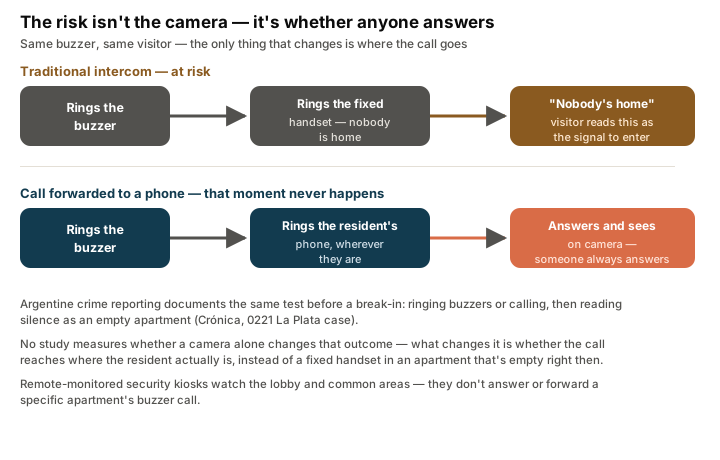
Why does this put anyone slow to reach the phone at greater risk?
Because the buzzer test doesn’t distinguish “nobody’s home” from “somebody’s home but didn’t make it in time.” A traditional intercom handset rings a fixed number of times and then cuts off; in a larger apartment, or for a resident with limited mobility, crossing the apartment before it cuts isn’t always fast enough. From the street, that missed call looks exactly like an empty apartment — even though someone inside simply didn’t get there in time.
That matters more in Argentine buildings than it might seem: the City of Buenos Aires is the country’s oldest jurisdiction by population, and nearly 4 in 10 residents over 65 live alone (38.2%, Encuesta Anual de Hogares 2024) — with no one else in the home who might reach the phone faster. It’s the same population we’ve already covered from the adoption angle in is a smart intercom easy to use for older residents?; the point here is different — it’s not that they don’t know how to use the handset, it’s that the physical distance to it leaves them on the wrong side of the buzzer test for longer.
What changes when the call rings straight on a phone?
Distance stops mattering. If the call rings on the phone already in your hand or your pocket, there’s no hallway to cross and no seconds to lose before it cuts off — you answer from wherever you’re standing. It’s the same idea already offered by at least one Argentine wireless-intercom provider, which advertises answering the street buzzer from your phone while in a different city, as long as you have a data connection (Perfil Córdoba).
DoorLink works on that same principle: the call from the street panel rings your phone wherever you are in the apartment, or outside it. You see who rang on camera and answer as if you were standing right at the door. And a single unit can have every resident’s phone linked at once, so if more than one person lives there, whoever reaches their phone first answers — it doesn’t depend on one person or one room.
Do remote-monitored security kiosks solve this?
Not exactly, because they’re not aimed at the same problem. Remote-monitored security kiosks (tótems) sold to buildings are designed to monitor the lobby and common areas with a human operator watching remotely — that’s what their own product pages describe (USS, SGN Seguridad) — not to answer or forward a specific apartment’s buzzer call. An operator watching the lobby on camera isn’t the same person who can decide whether to let in whoever rang your unit.
Do apartments carry the same risk as houses?
Generally not: apartment buildings are a comparatively harder target than standalone houses, because they have a single controlled entrance instead of several isolated access points. A victimization study by Universidad Torcuato Di Tella, cited by La Nación, found that 14% of house-dwelling households had been burglarized, versus 3% of apartment-dwelling households — a four-to-fivefold difference.
That safety margin isn’t constant year-round, though: according to Ministry of Security data cited by Minuto Uno, the City of Buenos Aires reports an average of about 15 home robberies a day during December and January, when more apartments sit empty over the summer holidays — exactly the season when the buzzer test produces more false “nobody’s home” positives.
What’s actually worth doing about it?
It doesn’t come down to buying a fancier camera or convincing the whole building to adopt a new app. It comes down to making sure that when someone rings your apartment’s buzzer, the call reaches you — on your phone, no matter which room you’re in or how quickly you can move — instead of a fixed handset that cuts off before you get there. It asks nothing new of the visitor, who still presses the same physical button as always, no QR code or mobile data required, as covered in physical button or QR code.
If your building’s HOA is already weighing whether to modernize the intercom, the per-apartment cost breakdown — one-time install plus monthly fee, measured against what the building already spends on upkeep — is in how much does a smart intercom cost for an HOA, and you can get your building’s exact number from the calculator.